
Parent guides · Ages 5 to 8 (The Explorers)
Riddles for kids, with answers
How to share riddles with children aged 5 to 8: who-am-I clues, giving hints, letting them write their own, with free riddle cards to print.
A riddle is a tiny puzzle made of words. It asks a child to listen closely, hold the clues in mind and think around a corner. For ages 5 to 8 (The Explorers), riddles fit into car rides, queues, bath time and the walk to school, with nothing to carry but a few cards in a pocket.
Start with who-am-I riddles
Animal riddles are the easiest way in. Each one gives two or three clues about something your child already knows: "I have a trunk but I never pack it. Who am I?" The clues point at one answer, and the joke in the clue makes it fun to get.
The animal riddle cards have twenty, from the elephant to the beaver, with the answer printed upside down on each card. No second page to line up on the printer: cut, shuffle, read.
Read slowly, then wait
Read the riddle once, slowly, then stop. Give your child time. The silence is where the thinking happens. If they ask, read it again; hearing it twice is not cheating.
If nobody guesses in a minute, give one more clue of your own. "It is grey, and it is very big." Then wait again.
A sensible wrong guess counts
When your child guesses "a suitcase" for the trunk riddle, ask why. They are using the clue, and they have found a second meaning of "trunk". Praise the reasoning: "Yes, a suitcase is a trunk too. What else has a trunk?" Riddles are word play, and spotting the play is the skill.
Then the harder ones
Once animal riddles are easy, move to riddles about everyday things: "What gets wetter the more it dries?" These need a child to think about how a word can mean two things at once. The riddle cards for ages 8 to 12 have twenty of these, and confident readers of 7 and 8 often enjoy them.
Let them write their own
Every riddle set has four blank cards. Ask your child to pick an animal and write three clues about it, with the answer on the back. Writing a riddle is harder than solving one: a child has to choose clues that are true but not too obvious. Then they read it to you, and you guess.
Good first riddles start with "I have" or "I live": "I live in the sea. I have eight arms. Who am I?"
Tongue twisters for a change
When the riddles run out, switch to tongue twisters. The tongue twister cards have twenty to say three times fast, and four blanks to write your own. The guide to tongue twisters has tips for getting them out without tripping.
Make it a game
Take turns: one riddle each, and a point for every correct answer and every sensible wrong guess. Or play in teams at the dinner table. The first team to three points picks the next card.
For a longer game night with older children, the guide to family game night has would-you-rather cards, detective cases and space quizzes.
Watch and guess
Each Activity Short on YouTube is about a minute with one thing to do. Before the maze with Tick starts, ask: who is Tick, and what is he looking for? Guess first, then watch to find out.
Puzzles on paper
For quiet puzzles to do alone, Kudimi's Maze Adventures has mazes for ages 5 to 8 that get harder page by page, and the mazes guide explains how to start.
Meet Max, the monkey who loves a riddle, and Tick, the mouse who reads the answers upside down.
Watch it together
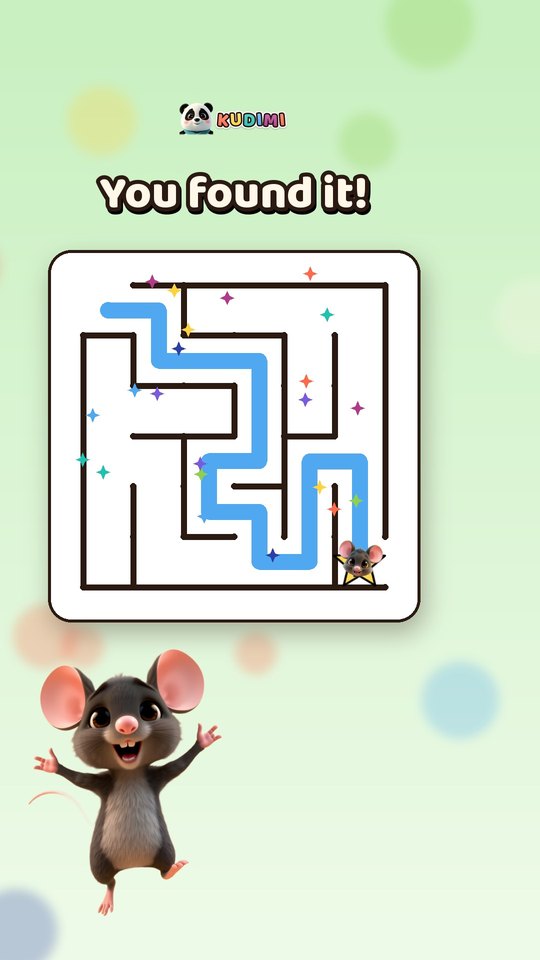
Can You Solve the Maze? Help Tick Find the Star · YouTube
Free printables with Kudimi Family
127 activity sheets to print free in US Letter or A4, from tracing and counting to mazes and dot to dot. Kudimi Family is a free account for parents and carers.
More parent guides
Follow Kudimi on YouTube and Instagram. All parent guides.